
Around the time the Martin Scorsese film of this book came out, the author David Grann had a new nonfiction book coming out The Wager, A Tale of Shipwreck, Mutiny and Murder.
The film about the Native American Osage murders was three and a half hours long and I knew that was not for me, not because the story isn’t important, but the way stories like this are portrayed cinematically in the 21st century is not for me.
I did read The Wager and thought it was excellent, and I knew if I ever came across Killers of the The Flower Moon, I would read that too.
Last week I visited our local English bookstore and there was a second hand copy sitting on the shelf, so I snapped it up and read it in a day.
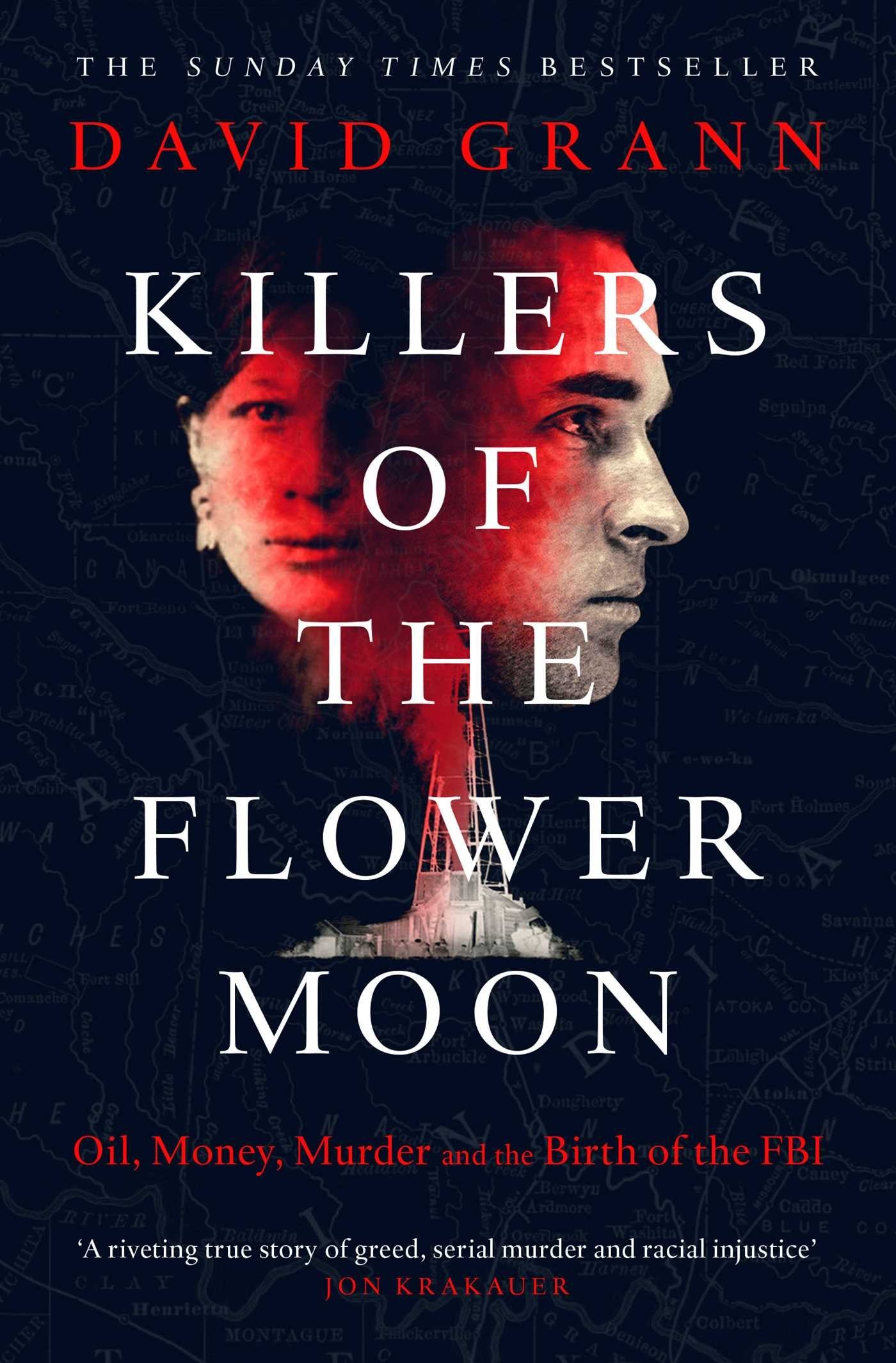
Killers of the Flower Moon
So what is that title all about?
“In April, millions of tiny flowers spread over the blackjack hills and vast prairies in the Osage Territory of Oklahoma. There are Johnny-jump-ups and spring beauties and little bluets… In May, when coyotes howl beneath an unnervingly large moon, taller plants such as spiderworts and black-eyed Susans, begin to creep over the tinier blooms, stealing their light and water. The necks of the smaller flowers break and their petals flutter away, and before long they are buried underground. This is why the Osage Indians refer to May as the time of the flower-killing moon.”


Land and Oil – From Greed to Domination to Dehumanisation
Grann twists the metaphor to describe what happened to the Osage people when white settler individuals, driven by greed, racism and a total lack of empathy conspired to kill multiple members of families for their wealth and rights to oil profits.
In nature, one species nourishes the next, governed by the cycles of the Moon whereas the story he presents here, uses that phrase to describe a murderous cycle of greed and violence to annihilate and supplant the native Osage.
An Obsession with Wealth and Control
In the early 1870’s , the Osage had been driven from their lands in Kansas onto a rocky, presumably worthless reservation in northeastern Oklahoma, only to discover, decades later, that this land was sitting above some of the largest oil deposits in the United States. To obtain that oil, prospectors had to pay the Osage for leases and royalties.
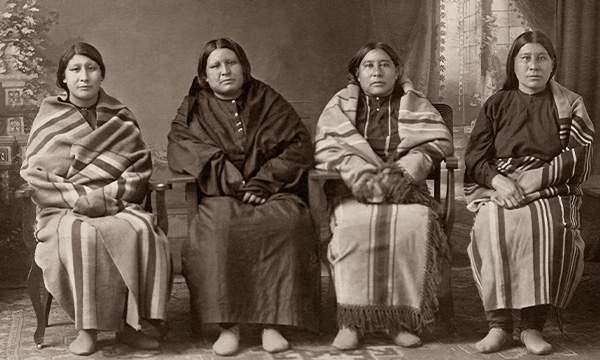
I raced through this book, enjoying how thorough it had been researched. It is divided into three parts, Chronicle One: The Marked Woman (or The Marked Family or The Marked Tribe) focuses on four sisters Mollie, Anna , Minnie and Rita (pictured below) and their mother Lizzie, all of whom find themselves in danger of being killed in an elaborate conspiracy, without knowing who or why.
Four Sisters Targeted
The story opens with the gruesome murder of Anna and then goes back to describe the events that lead the Osage people to be where they were living, how their lives were changed, the treaty that forced them to give up their lands or be declared enemies of the United States, the banned aspects of their languages and lifestyles, the imposed education and names.
In the early 1870’s the Osage were forced to cede nearly a hundred million acres of their ancestral land (between the Arkansas River and the Missouri River), ultimately finding refuge in a 50 – by – 125 mile area in southeastern Kansas. And it was in this place that Mollie’s mother and father had come of age.
Decades later it was discovered that this infertile land sat above some of the largest oil deposits in the country. To obtain that oil, prospectors had to pay the Osage for leases and loyalties. As a result, as oil revenues grew and their wealth accumulated, the Osage became the wealthiest people per capita in the world. However, severe controls were placed on their ability to access their own money.
Who Was Behind the Murders? A Texas Lawman Investigates
While the family got no help from the local sheriff they paid various private investigators to look into the murder of Anna, when Rita and her husband were killed. The community lived in fear and needed answers.
Chronicle Two: The Evidence Man turns the focus to Texas Ranger, Tom White, who becomes the government appointed (by Edgar Hoover) lead in an investigation, when a number of others who attempt to report back to authorities are mysteriously killed, hinting at a wider conspiracy. Tom White focuses on Mollie’s family when her mother mysteriously dies and Mollie becomes the sole survivor of her family.
Under Hoover, agents were now seen as interchangeable cogs, like employees in a large corporation. This was a major departure from traditional policing, where lawmen were typically products of their own communities. The change helped insulate agents from local corruption and created a truly national force, yet it also ignored regional difference and had the dehumanising effect of constantly uprooting employees.
A Wider Conspiracy Revealed
Chronicle Three: The Reporter circles back and relooks at these events and sees that they were part of a wider pattern of targeted murders, but this is in the 21st century, where there are few people left who can recall events. However, the archives and family testimony reveal the depth of this terrible vengeance against a marginalised population, just because in the process of being banished from their original lands to other infertile lands, they happened to land on undiscovered deposits of oil and became wealthy.
Brilliantly pieced together and a horror to read, how this family of women were targeted and those around them easily influenced to participate in it and the wounding legacy of future generations who lost so much of their family over the greed and jealously of remorseless white men.
Further Reading
Guardian: Killers of the Flower Moon by David Grann review – family murder, oil & the FBI by RO Kwon
NYTimes: The Osage Indians Struck It Rich Then Paid the Price
FBI History : Osage Murders Case – A deadly conspiracy against the Osage Nation and the agents who searched for answers
“The most common comment I have received is: ‘I can’t believe I never learned about this. I think that is a reflection to some degree of the underlying force that led to these crimes, which was prejudice.” David Grann
Author, David Grann
David Grann is an American journalist, a staff writer for The New Yorker, author of The Wager, The Lost City of Z, A Tale of Deadly Obsession in the Amazon, shortlisted for the Samuel Johnson Prize.
Killers of the Flower Moon: The Osage Murders and the Birth of the FBI was a finalist for the National Book Award and winner of an Edgar Allan Poe Award for best true crime book. It was adapted into a film directed by Martin Scorsese, starring Leonardo DiCaprio, Lily Gladstone, Robert De Niro, and Jesse Plemons.
His stories have also been published in the New York Times Magazine, Atlantic, Washington Post, Boston Globe, and Wall Street Journal.
In addition to writing, Grann is a speaker who has given talks about topics from Killers of the Flower Moon and the importance of historical memory to the dangers of complicity in unjust systems, and from the art of writing and detection to the leadership methods of explorers, such as Ernest Shackleton.
 Word by Word
Though a horror story indeed, this sounds like a must-read. (comment posted via the Reader, as WP won’t let me comment on your site again, for some reason.)
LikeLiked by 1 person
Will this book require a box of Kleenex? (heartbreak?)
LikeLiked by 1 person
No, it’s history so it’s not using literary devices to evoke an emotional reaction and neither does it use the kind of dramatic elements they use in film. It’s compelling and evidence based and has a wider scope than what the film covered.
LikeLike
Okay, that sounds better than the movie…I’ll put the nook on the TBR. Thanks for the feedback!
LikeLiked by 1 person
This book is a must read, for American history and the horror of human nature.
LikeLiked by 1 person
Thanks, Emma…I wanted to read it but was afraid I couldn’t handle the inhumanity of it all. I’ll put it on my TBR.
LikeLiked by 1 person
Read it, just don’t watch the film. The inhumanity is there, but there’s no needless dwelling on the acts, no scenes of the murders, just the investigation and the search for evidence to bring a case.
LikeLike
Sound advice, Claire, thanks.
LikeLiked by 1 person
I found this book particularly fascinating (and horrifying) because my family discovered oil on their own ranch in Oklahoma and became involved in the oil industry. Not the same area as the Osage land, but still I wonder how much they knew about and colluded in the injustices done. It’s certainly a story of reckless, amoral white greed and exploitation-the murder angle just makes that even more clear.
LikeLiked by 1 person
It is frightening, the premeditated element, how people planned not just the killings, but how they would profit from them, and who they controlled in order to achieve that. Also, the unwillingness of the local law authority to investigate. That tragedy and family pain continuing to exist into the 21st century. So many stories and secrets buried, I’m sure Lory.
LikeLiked by 1 person
Thanks for this thoughtful review, Claire. Having seen and admired the Scorsese film, I’m interested in reading this book as I do think it will give a sharper insight into the horrors of this story. (I can totally understand your not wanting to see a cinematic treatment of this, as it’s a very complex ans shocking sequence of crimes.).
I think I’m going to add to my audiobook queue as I often listen to non-fiction these rather than reading a physical book.
LikeLiked by 1 person
Thanks Jacqui, the book is an excellent investigative work, the result of years of research and reading archives and interviewing descendants and told in a factual, methodical way. I enjoyed understanding what really went on rather than seeing a dramatisation of what those killings and bad behaviours might have looked like, I couldn’t even watch the trailer.
I’m sure you’ll appreciate the book Jacqui.
LikeLike
I’ve read it, before the film went out. It’s an excellent book, like a thriller.
But knowing this is a true story, it’s horrifying. The sheer greed, racism and violence of these white people in Oklahoma is staggering.
I didn’t know about this episode of wealth in Oklahoma, how people got rich and that they were sort of famous for it at the time.
I really recommend this book.
LikeLiked by 1 person
It’s incredibly compelling and horrifying and I’m just glad to know that they actually persevered and solved this terrible crime, perhaps because it was unique being a family of 4 sisters, whereas others did not find justice.
Exactly, this whole episode of their rise as well as the subsequent fall seems to have been buried, which does seem to be common in many countries, burying their most shameful and despicable acts against the innocent.
LikeLike
I listened to Killers on audio and loved it! Great review!
LikeLike
Witnessing the birth of the FBI with this case was also quite fascinating.
LikeLiked by 1 person
Yes that reminded me of Kate Summerscale’s nonfiction true crime book The Suspicions of Mr Whicher, a murder investigation that coincided with the development of the new role of detective at Scotland Yard.
LikeLiked by 1 person
This must be interesting too!
LikeLiked by 1 person
Pingback: The Trees by Percival Everett (2021) – Word by Word
Pingback: The Mushroom Tapes (2025) by Helen Garner, Chloe Hooper, Sarah Krasnostein – Word by Word