
Reading Ireland Month
March is Reading Ireland Month, run by Cathy over at 746books.
An island of approximately 7 million people, it has a successful and supportive literary culture, including four nobel prize winners (George Bernard Shaw, William Butler Yeats, Samuel Beckett, Seamus Heaney) and six Booker Prize winners (Iris Murdoch, John Banville, Roddy Doyle, Anne Enright, Anna Burns, Paul Lynch), plus an honorable mention for William Trevor, who never won, but was shortlisted five times.
Language and Life Intertwined
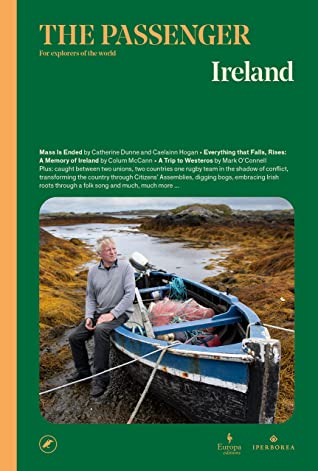


If you’re interested in a contemporary insight into Irish culture, literature and history, I highly recommend The Passenger – Ireland (reviewed here), which features long form essays, investigative journalism, literary reportage and visual narratives. It takes us beyond the familiar stereotypes to portray the country’s shifting culture and identity, public debates, sensibilities of its people, its burning issues, pleasures and pain. It was published by Europa Editions in March 2022.
One of the essays, An Ocean of Wisdom by Manchan Magnan, a man fascinated by the Irish language and its connection to fishing, tells of his travels to three Gaeltachtai (Irish speaking) areas uncovering local words and phrases that expressed aspects of the sea, weather and coastal life. He captured linguistic nuances that described a way of life fast disappearing and shared the complex reasons behind it.
More Ireland Island Literature, The Colony
My first book for reading Ireland 2025 is the excellent novel The Colony by Audrey Magee. This had rave reviews everywhere and I have long been wishing to read it. It did not disappoint, it has many thought provoking themes, yet can be read at quite a pace.
Mr Lloyd, an English man has come to an island, a rock three miles long and half a mile wide to paint the cliffs and have an authentic experience. He is trying to find inspiration and revive his career (and life).

We get to know his type immediately in the sardonic opening pages, which are illustrated on the cover of the copy I read. A man being rowed across the water to the rock where he will spend the summer, wants to recreate an authentic experience he’s seen a picture of somewhere. Reality, nothing like a still-life.
He looked down again, at his backpack, his easel, his chest of paints bound already to the journey across the sea in a handmade boat. He dropped his right leg, then his left, but clung to the ladder.
self-portrait I: falling
self-portrait II: drowning
self-portrait III: disappearing
self-portrait IV: under the water
self-portrait V:the disappeared
Let go, Mr Lloyd.
I can’t.
You’ll be grand.
The people on the island cater to his needs while fifteen-year-old James is curious about painting and drawing. He begins to learn, to practice, to observe what My Lloyd is incapable of seeing. The islanders have asked My Lloyd to respect certain privacy’s, lines he doesn’t take long to cross.
Rival outsiders on a mission
A while later, another man will arrive for the summer, Mr Jean-Pierre Masson, a Frenchman, returning for his fourth summer.
You speak the language Mr Masson?
Yes, I study Irish, or Gaelic, as you prefer to call it.
I have no preference.
Then we’ll go with Irish.
Masson drank from his cup.
I’m a linguist, Mr Lloyd, and I specialise in languages threatened with extinction.
And you’re here to save Gaelic?
The novel observes the effect these two outsiders have on the islanders, the rivalry and antagonism between them and the inability of the islanders to stop the change these two herald.
Lest We Forget
Interspersed between the chapters, single pages in short paragraphs, recount acts of terrorism, the names and details of those who are victims, targeted by different sides of the Irish divide. Thus the novel depicts the external colonising forces and the internal country conflict on the people.
Alexander Gore is a full-time member of the Ulster Defence Regiment standing outside his barracks on Belfast’s Malone Rod just after eleven on Wednesday morning, June 6th. He is twenty-three years of age, Protestant and has been married for four months. His nineteen-year-old wife is pregnant with their first child.
A truck drives down the Malone Road towards the barracks. Two IRA men in the truck open fire and kill Alexander Gore.
In addition to the islanders, there is the ghostly presence of the three fishermen who drowned, their absence keeping some endlessly waiting, anchored to that rocky outcrop, as if expecting them still to return.
Three good men lost on an autumn day. My son-in-law, my grandson and my grand-daughter’s husband. Gone. Never to come home. Not even for their own funerals. That was a hard time, JP. But as I say, you get hard times wherever you are. They have a great way of following people. Though it took a long time for the island to recover.
The Painter and the Academic, neocolonialism at work
Both visitors have backstories that reveal more about them and question their motives. They discover they can take more than what they initially came for and neither hesitates to expand their remit, because it serves them, it takes them away from looking at themselves, at their own story.
The islanders see all, some stuck in their ways, others with more freedom to slip in and out of what is expected and others have the desire to rebel or seek opportunity. As the visitors time on the island comes to an end, true colours are revealed, change is challenged by the old order and young James weighs up his options.
I very much enjoyed the reading experience and the delving into the different motivations of all the characters. The dialogue was excellent, the humour biting, the prose sometimes poetic and spaced out on the page, other times fluid like the incoming and outgoing tides, occasionally dense when it delved into the political and linguistic aspects and violent when those extracts are shared.
Highly Recommended!

Have you read The Colony? Are you reading any Irish literature this month? Let me know in the comments below.
Further Reading
Guardian review: The Colony by Audrey Magee review – island life at a distance by Jonathan Myerson
Read rave reviews of The Colony by Jacqui at JacquieWine’s Journal, Kim at Reading Matters (her favourite book of the year 2023), Susan at A Life of Books, Sue at Whispering Gums and Lisa at ANZ LitLovers.
Audrey Magee, Author
Audrey Magee was born in Ireland and lives in Wicklow. She worked for twelve years as a journalist.
Her first novel, The Undertaking, was shortlisted for the Women’s Prize for Fiction, for France’s Festival du Premier Roman and for the Irish Book Awards. It was also nominated for the Dublin Literary Award and the Water Scott Prize for Historical Fiction. The Undertaking has been translated into ten languages and is being adapted for film.
Her second novel, The Colony was longlisted for the Booker Prize 2022 and shortlisted for the Orwell Prize for Political Fiction (2022).
 Word by Word
What a great book to kick off Reading Ireland month! I love your description of the prose being occasionally “fluid like the incoming and outgoing tides” — that is such a wonderful metaphor. Thanks so much for linking to my review — it’s a novel that has stayed with me all these months later.
LikeLiked by 1 person
I recall your review and that it being one of your top reads that year, that as when I decided I had to get a copy, and saved it to review in March. It’s a relatively easy read but with so much more going on thematically.
LikeLiked by 1 person
Thanks for the mention!
LikeLiked by 1 person
I STILL haven’t read The Passenger – Ireland, even though I promised myself I would when you reviewed it. I’m so glad you’ve joined the long line of reviewers who’ve enjoyed The Colony. It was definitely one of my Books of 2024.
LikeLiked by 1 person
Thanks for the link, Claire. I’m so glad you enjoyed this one – a particularly striking take on colonialism.
LikeLiked by 1 person
Yes, it was interesting how it could be looked at in that way, and also the personal histories that impacted what each character became obsessed with and sought to satisfy by their visit yo the island.
LikeLiked by 1 person
This does sound wonderful. I’ve read Garrett Carr’s The Boy from the Sea, review out on Monday
LikeLiked by 1 person
That sounds like a good one too Liz.
LikeLiked by 1 person
I liked Magee’s The Undertaking but with reservations – I struggled with the lack of interiority, and I think this is what is making me hesitate over The Colony as well. But it’s clearly a very different beast from her first novel.
LikeLiked by 1 person
The colony starts out like that with short clipped dialogue in an entertaining action scene, the “authentic” bost ride to the island, but the develops into something more reflective. I haven’t read her previous work.
LikeLike
Loved remembering this book through your post, including those great quotes. It’s such a powerful read about a complex situation … so Irish … my reading group loved it too.
LikeLiked by 1 person
Thank you, I’m glad it reminded you of an enjoyable reading experience. It is indeed a thought provoking story, so much is affecting the islanders, at the same time as its just another summer passing by.
LikeLiked by 1 person
Pingback: It’s Reading Ireland Month 2025!
I loved The Colony, Audrey Magee is a great writer.
LikeLike
I’m so glad you enjoyed The Colony, Claire, and many thanks for linking to my review, that’s so kind of you!
Like Kim, I was struck by your beautiful description of Magee’s prose: “sometimes poetic and spaced out on the page, other times fluid like the incoming and outgoing tides, occasionally dense when it delved into the political and linguistic aspects and violent when those extracts are shared.” T
That’s such a great way of expressing it. I thought Magee’s usage of language was extraordinary throughout. The way she moved from one character’s POV to another felt so smooth and self-assured, especially when those transitions came in the middle of a single sentence. That could have been tricky to follow, but in practice it wasn’t. I never felt lost or confused, which is a testament to Magee’s skill as a writer.
LikeLike
This is yet another book on the unending list of novels I’ve heard lots of good things about and would like to read. Lovely review, and one that certainly maintains The Colony’s place on that list of mine!
LikeLiked by 1 person
Thank you, yes that’s how it got on my list too, I was pretty sure it would work for me, I do like books that observe the impact of outsiders on people and places, it certainly does that.
LikeLiked by 1 person
A rare event for the IRA to do a drive by on the Malone Road (sorry to be so specific – that’ll be my 70s Belfast upbringing)
LikeLike
Few of us would understand that detail I’m sure Jackie.
Have you read The Colony? It took me a while to understand all those references, I’m not even sure that I do, but they are there acting on the reader, drip fed throughout the narrative.
LikeLike
I haven’t read the book but will look out for it
LikeLike