Where I End by Sophie White

March is Reading Ireland month and I have been in an early spring mode since mid Feb, attending to other activities, nature excursions, writing and editing projects, reading and listening to texts while reflecting elsewhere. There is a new energy present that demands it of me and I follow it contentedly.

I did write some notes on one Irish book I have read this month. I love to participate in Cathy’s March reading month, so here it is. I will continue (intend) to read Irish literature this year, although I am making writing and editing more of a priority, so there may be fewer reviews here.

Review

This was an unusual read for me, not the kind of novel I usually choose, one I selected because I admire the Irish publisher Tramp Press, who publish Doireann Ní Griofa and Sara Baume.

Where I End might be horror, but I’m not even sure since I’ve never read that genre before. It was described by the Irish Independent as

‘a truly different Irish novel. One that entwines Irish myth, the reality of human bodies, life and death, and traditional gothic horror in a macabrely beautiful and, in the end, redemptive dance.’

The novel won the Shirley Jackson Award (2023), an award that recognises ‘outstanding achievement in the literature of psychological suspense, horror, and the dark fantastic’, voted on by writers, critics, editors, and academics.

It depicts a short period in the life of a teenage daughter caring for a mute, incapacitated mother, who appears to have been that way since she was a baby. Her paternal grandmother, who also lives with them is about to start a job that will absent her from the house, allowing Aoileann a freedom and recklessness she has not until now experienced.

It reminded me of the experience of reading another Irish author, Jan Carson’s The Firecatchers because it depicts a character who has no faculty for empathy. But the feeling that it evoked was different, White’s character Aoileann compels the reader to want to stay with her and find out if there will be a transformation, a redemption, despite all the signs of foreboding.

The decision to end this thing comes on slowly, like light filling a room after a fathomless night. It began like this:

The opening line of the first chapter. We observe her as carer of ‘the thing’ which I ask myself, is that her mother? And when she occasionally uses that word, I realise, yes it is.

There is a question I have never asked. On the nights that we find her far from her bed, her ragged hands reaching towards nothing, the idea prods me. Is the bedthing trying to get away? Are we doing this to her?

This the mystery is seeded. Why does this young woman who daily cares for her immobile mother refer to her in such a way? What happened that this situation should have come about and why doesn’t anyone know what goes on here? Why do people look at her strangely and spit as she passes by?

In the opening pages before chapter one, she describes the three things that describe her limited world. My mother. My home. My house. A woman trapped inside a body, a small insular community living on an island, three women living in a house no one visits, except the man.

The islanders all share a similar look, the result of genetic material passed back and forth for so many generations – it has distilled into a distinct, unpleasant appearance. Móraí has it too. Me, less so as my mother is from the outside; Dad is the same as me – a little watered down because his father was also a mainlander.

It is a disturbing read that the arrival of a visitor, an artist with a young baby at first seems like an opportunity for growth and healing, but increasingly becomes another avenue of dysfunction, a creeping fear of what is in danger of happening.

It speaks to both the fear and allure of the outsider, of the extremes of dysfunction that a lack of maternal nurturing and love can bring and the desire to overcome and escape all of that.

The writing and descriptions were brilliant, moving between enticing literary prowess and elements of the macabre. Somehow this is balanced out in a way that made me both wary of what was coming but unable to stop turning the pages.

Very well portrayed, a haunting, compelling read.

Further Reading

Irish Times Interview, Sophie White, Where I End – a horror about a young woman’s attempts to find motherly love, and to get to the bottom of family secrets that made her who she is. Niamh Donnelly

Sophie White, Author

SOPHIE WHITE is a writer and podcaster from Dublin. Her first four books, Recipes for a Nervous Breakdown (Gill, 2016), Filter This (Hachette, 2019), Unfiltered (Hachette, 2020) and The Snag List (Hachette, 2022), have been bestsellers and award nominees. Her fifth book, the bestselling memoir Corpsing: My Body and Other Horror Shows (Tramp Press, 2021), was shortlisted for an Irish Book Award and the Michel Déon Prize for non-fiction.

Sophie writes a weekly column ‘Nobody Tells You’ for the Sunday Independent LIFE magazine and she has been nominated for Journalist of the Year at the Irish Magazine Awards, Columnist of the Year at the Irish Newspaper Awards and for a Special Recognition Award at the Headline Mental Health Media Awards.

TV adaptations of her first two novels are in development and she is co-host of the comedy podcasts Mother of Pod and The Creep Dive. In addition to writing literary horror, Sophie has written commercial fiction titles for Hachette, such as the recent My Hot Friend.

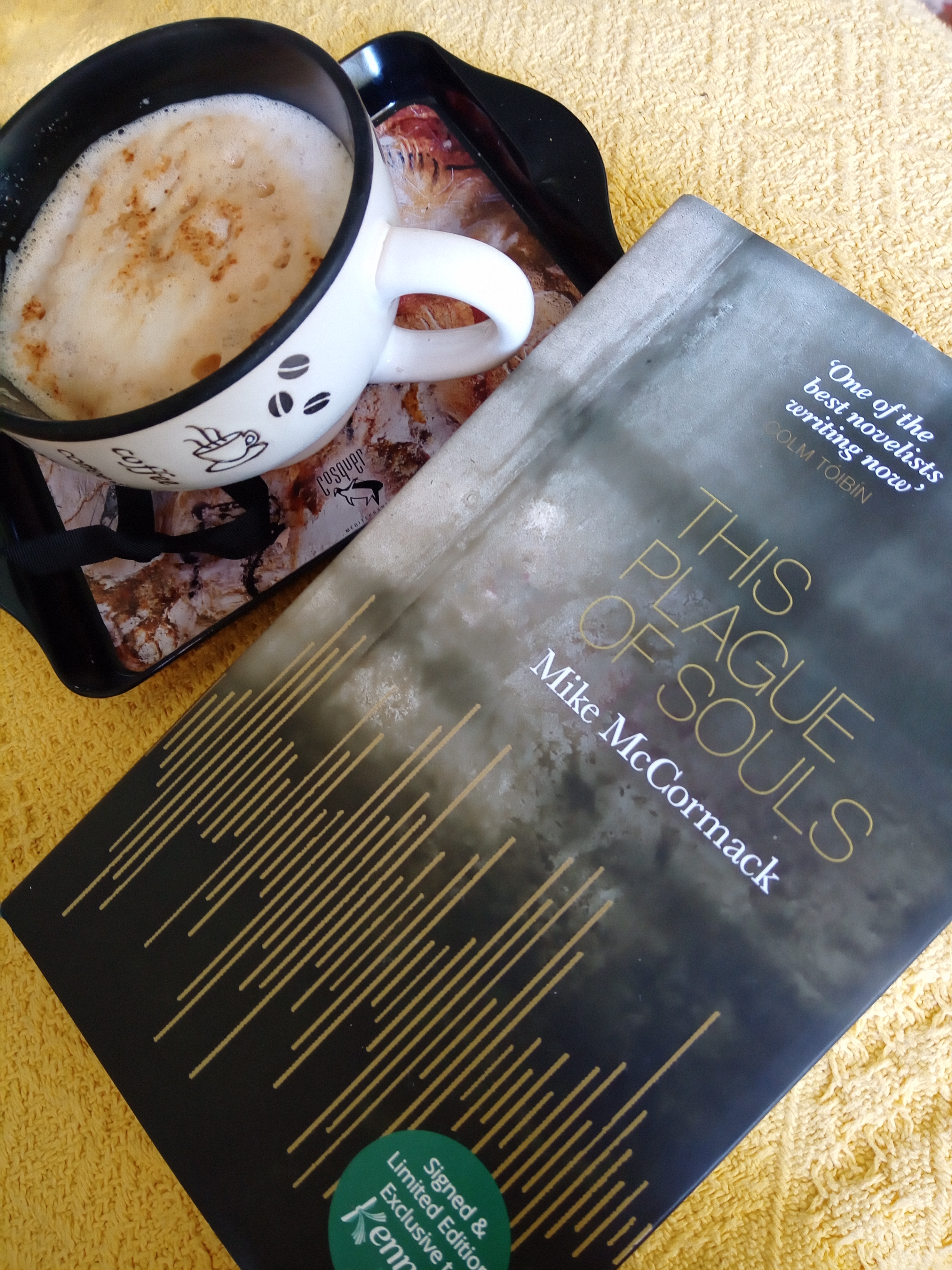
This Plague of Souls by Mike McCormack

Well, that wasn’t what I was expecting. Perhaps the first half, which felt like a different novel, one that felt familiar in an Irish rural novel kind of way, featuring a lonesome protagonist, Nealon, who has returned to the abandoned home and found it empty of his wife Olwyn and child Cuan, who hadn’t waited to hear the outcome of the charges that have kept him in prison the last 10 months.

An Old Irish Cottage of Memories

As he wanders about the house, certain objects awaken memories, of his parents, now long dead and more recently his wife Olwyn, who removed everything in the house that had belonged to them and did him a favour by cleaning and renovating it single-handedly. In protest he drags their old couch into the back lawn and just sits there.

We don’t know why he was imprisoned, what he was charged with, who his wife was, where she is.

Solar Bones Tramp Press Irish experimental fiction

The only evidence of a life or connection outside this empty cottage, is a persistent caller, who calls every day and seems to know everything about his life.

He conveniently repeats to Nealon everything he knows about him, though we don’t know if any of it is true, because the protagonist rejects everything he says, neither accepts or denies and even in the thoughts shared on the page, chooses not to think about (or the writer chooses not to share) any thoughts relating to the activities he describes.

I do not highlight one single passage until page 64 and then it is this I note, words exchanged in one of their cryptic telephone conversations:

‘I’ll tell you this: there is a great shortage of imagination out there, you couldn’t underestimate it.’
‘I wouldn’t know about that. I have noticed that there is no shortage of foolishness.’

An Alternate Reality or A Spark of Imagination?

Finally they will meet and the story becomes more surreal, at this point I thought, this is actually going to be revealed as science fiction, there is probably an alternative reality going on here – isn’t there? Because it’s starting to get kind of frustrating almost boring; but clever yes, the writing is polished, it’s relatively easy to read, but for this reader, there is nothing meaningful or all that intriguing about it, I feel the edge of disappointment ahead of me, as there are so few pages left to read. I start theorising and make up my own story about what is going on (I won’t bore you with that).

As the man says himself articulating both his conundrum and my own :

‘So I understand the architecture of the whole thing, the grandeur and ambition of the entire construct. But not the motive behind it. What is it all about? What does it hope to achieve? Is it some noble enterprise – as I hope it is – or something else entirely? Something squalid and rotten to the core.’

Scattered throughout the text are occasional sentences that hint at Nealon’s understanding, words that come from his ‘now’ wherever that is.

It took him a long time to recognise it as chaos and he wonders now how he could have mistaken it as anything else.

We have learned that in prison there was a complete lack of mind-sharpening engagement that threatened to turn in on itself and close him down, however nothing about the character thus far indicates his capability. He is a loner, just as his name indicates, Nealon – a.l.o.n.e with a capital N.

Curiosity Can Kill the Cat

Ultimately, despite his better judgement, out of curiosity or nothing better to do, or perhaps he really is interested in finding out where his wife and child are, he is lured into meeting the man, and while focusing on not really saying anything, he may have talked himself into a trap.

Photo by Jack Redgate on Pexels.com

As he travels from the West of Ireland towards the city, he becomes aware of some kind of threat looming over the country.

On the edge of insight, when it comes it may be too late. This constant feeling that he is about to realise something drives the novel forward and creates a sort of tension.

In a way, it reminded of the book I just read Margarita Garcia Robayo’s The Delivery, she uses a similar introspective technique to keep the reader from knowing exactly what is going on, however throughout the course of novel, there are many more morsels of humanity, she too is a loner, but life and love push their way in on her – you can’t escape the community.

The author who describes the novel as ‘part metaphysical thriller, part roman noir’ did ask himself the question and was aware he may alienate some readers, as he says in an interview with the Irish Times.

Would it be possible to write a book of which it would be impossible to speak, where I don’t know what happens, and how to make that artistically credible and skilful without it coming across as clueless, as an authorial failure?

Why Did I Read This?

I chose to read this book because of all the good reviews of Solar Bones, which I will still read, and also because Mike McCormack was picked up by Tramp Press, one of my favourite Irish publishers, who also publish my top two Irish authors, Sara Baume and Doireann Ni Ghriofa.

Author, Lisa McInerney’s blurb on the back cover was closest to my reading experience, when she says:

‘A darkly marvellous novel: at once intimate, domestic, and poignant, then speculative and hard-boiled and wild’

Mike McCormack, Author

Mike McCormack’s previous work includes Getting it in the Head (1995), Crowe’s Requiem (1998), Notes from a Coma (2005), which was shortlisted for the Irish Book of the Year Award, and Forensic Songs (2012).

In 1996 he was awarded the Rooney Prize for Irish Literature and in 2007 he was awarded a Civitella Ranieri Fellowship. Solar Bones (Tramp Press, 2016) won the Goldsmiths Prize, the Bord Gáis Energy Irish Book Award for Best Novel and Best Book, and the Dublin International Literary Award (previously known as the IMPAC), and was nominated for the Booker Prize.

Mike McCormack lives in Galway with his family.