
I came across this author by chance having seen another of her books reviewed and after a period of not reading, her novel(s) sounded like something I’d quite enjoy as a way back in to reading. There were comparisons made to Anne Tyler, of whom I’ve read and reviewed a couple of novels here Ladder of Years and A Blue Spool of Thread, however having now finished I would say this offers much more beneath the surface of plot.
 What I wasn’t expecting was to then see this novel long listed for the Booker Prize a short while after I requested it. Doubly intrigued, as this is the only book on that list I have, I began to read.
I loved it.
Not only was it the good choice I had expected for my own personal reasons, it exceeded my expectations in so many ways.
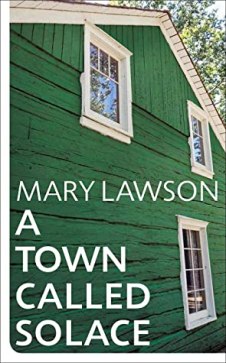
The title is both intriguing and promising and the cover, the way it zooms in on the house in a way that shows little else around it, is such an apt metaphor for the three lives it focuses on, those three windows into their worlds, and the three time sequences it immerses in to portray them.
A character driven mystery that explores boundaries and trust, the characters and their voices are superbly portrayed, they are like closeups, snapshots of little action, complex inner worlds, all of whom have been tilted in some way and are in the process of finding their upright, their wings even; yet there is a clear, interlinked story that ties them together keeping the reader engaged and the plot moving forward at a good pace.
I came to think of these three characters, Mrs Orchard (Elisabeth), the grown up child and previous neighbour of Mrs Orchard, now adult (Liam), and 8 year old current neighbour of Mrs Orchard (Clara), as depicting narratives of past, present and future, that overlap.
When the story begins we meet Clara standing at the window of her house, watching obsessively, waiting for her sister Rose (16) who has run away from home. She is waiting for any sign of her return and is disturbed to see a strange man carrying boxes into Mrs Orchards home next door.
The Inner Journey (Anti-hero)
Rose having gone missing may appear to some as the central drama, however each of the three characters are embarking on their own inner quest that this drama brings to light. Rose and her parents are not central characters, and the mystery of Rose’s disappearance is not allowed to take over the narrative.
This may prove to frustrate some, so tuned in are we to the more dramatic story pushing in to take centre stage. Here, the larger than life character, though involved in the more dangerous narrative, is made into a secondary character, kept at a distant. It’s the Penelope versus Odyseuss dynamic again, as recently depicted in Brenda Lozano’s excellent Loop.
More than disturbed, Clara is anxious because she has the keys to the house to enable her to feed the cat Moses while Mrs Orchard is in hospital. She’d promised she wouldn’t be gone long. Through Clara’s perspective we observe how confusing childhood can be when adults put so much effort into lying and withholding truth from them. In reality, they are extra sensitive to everything outside of and beyond words, cues that enable them to feel truths, therefore making them mistrust adults, whose words deny their truth.
But she had been away long, she’d been away weeks and weeks. Clara had run out of cat food several times and had to ask her mother for money so that she could go and buy some more. (This was before Rose disappeared, when everything was normal and Clara could go wherever she liked.) She’d expected Mrs Orchard to be more reliable, and was disappointed in her. Adults in general were less reliable than they should be, in Clara’s opinion, but she’d thought Mrs Orchard was an exception.
The Lying Life of Adults
Photo by Renato Rocca on Pexels.com
Clara doesn’t know this yet, but Liam remembers what it was like to be that child and he is the one adult who doesn’t lie to her. But in order to gain her trust, he will be required to step outside his own comfort zone and finds himself getting involved in a community and the lives of people he had no intention of knowing. In the midst of his own mid-life crisis, this unexpected event had given him a welcome distraction, however he had planned to stay 2 weeks and leave.
By six in the evening, nightmarish northern roads notwithstanding, he was walking up the steps of Mrs Orchard’s porch, with Toronto, his career and his marriage behind him.
And now, not much more than twelve hours later, somewhat dazed and very short of sleep, he was sitting in a strange house, which he happened to own, trying to explain it all to a cop.
In an entertaining subplot to his story, his effort to fix a leaking pipe under a sink miraculously leads to him to become the builder’s labourer, in on of those familiar scenarios of “well in order to fix that, first we’re going to have to fix the roof and unfortunately…”
‘How much is all this going to cost?’
‘Materials and labour. Biggest cost is labour, but with you working for free I’ll knock a third off that.’
Liam’s narrative happens ahead of Mrs Orchard’s and Clara’s narrative occurs ahead of Liam’s. It is so subtle and yet so clever as it creates a kind of mystery within the individual story of each character. So we sometimes read of the same event later from a different perspective.
Angelic Attendants
Elisabeth is in hospital (in the past because in the present we know she has already passed away) and her narrative uses the second person (You) as she is speaking to her dead husband (of many years now), who is very present for her, a sign to the reader of how close to her own passing is likely to be. As she speaks to her husband, she is recalling a period many years ago when the boy Liam lived next door with his family. Little clues drop indicating that something happened, something only Elisabeth now remembers.
Times without number I have asked myself how it could have come to that. Now, from a distance thirty years I can see the answer clearly: little by little.
The writing is superb and atmospheric, the structure is sophisticated and yet flows with ease you could read this and be completely unaware of it. The individual voices of the characters are pitch perfect and atmosphere created, remarkable. The drama is understated yet palpable and the mundane slowly gets filled with intrigue and curiosity was the layers are revealed. And it made me laugh out loud – often, little surprises and a fabulous last laugh for the closing scene.
I don’t know if this will make the shortlist but I totally understand why it has been nominated. I’m excited to read more of her work, because this was brilliant.
Highly Recommended.
Mary Lawson, Author
 Mary Lawson was born and brought up in a small farming community in southwestern Ontario and moved to England after graduating from McGill University with a degree in psychology.
She is the author of three previous nationally and internationally bestselling novels, Crow Lake, The Other Side of the Bridge, and Road Ends. Crow Lake was a New York Times bestseller and was chosen as a Book of the Year by The New York Times and The Washington Post, among others. The Other Side of the Bridge was longlisted for the Booker Prize.
Further Reading/Listening
Q & A Interview: In conversation with novelist Mary Lawson by Kobo
Video Interview: Reader Meets Writer, Wiley Cash interviews Mary Lawson on A Town Called Solace
N.B. Thank you kindly to the publisher Random House UK for providing a copy for review via Netgalley.
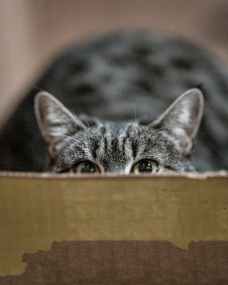
Photo E.Grossgasteiger on Pexels.com
 A Passage North begins with a message from out of the blue: a telephone call informing Krishan that his grandmother’s caretaker, Rani, has died under unexpected circumstances. The news arrives soon after an email from Anjum, an impassioned yet aloof activist Krishnan fell in love with years before while living in Delhi, stirring old memories and desires from a world he left behind.
 A woman invites a famed artist to visit the remote coastal region where she lives, in the belief that his vision will penetrate the mystery of her life and landscape. Over the course of one hot summer, his provocative presence provides the frame for a study of female fate and male privilege, of the geometries of human relationships, and of the struggle to live morally between our internal and external worlds.
 The Promise charts the crash and burn of a white South African family, living on a farm outside Pretoria. The Swarts are gathering for Ma’s funeral. The younger generation, Anton and Amor, detest everything the family stand for, not least the failed promise to the Black woman who has worked for them her whole life. After years of service, Salome was promised her own house, her own land… yet somehow, as each decade passes, that promise remains unfulfilled.
 In the dying days of the American Civil War, newly freed brothers Landry and Prentiss find themselves cast into the world without a penny to their names. Forced to hide out in the woods near their former Georgia plantation, they’re soon discovered by the land’s owner, George Walker, a man still reeling from the loss of his son in the war.
 From her place in the store, Klara, an Artificial Friend with outstanding observational qualities, watches carefully the behaviour of those who come in to browse, and those who pass in the street outside. She remains hopeful that a customer will soon choose her, but when the possibility emerges that her circumstances may change for ever, Klara is warned not to invest too much in the promises of humans.
 Samuel has lived alone for a long time; one morning he finds the sea has brought someone to offer companionship and to threaten his solitude…
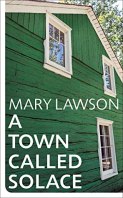 Clara’s sister is missing. Angry, rebellious Rose had a row with their mother, stormed out of the house and simply disappeared. Eight-year-old Clara, isolated by her distraught parents’ efforts to protect her from the truth, is grief-stricken and bewildered. Liam Kane, newly divorced, newly unemployed, newly arrived in this small northern town, moves into the house next door – a house left to him by an old woman he can barely remember — and within hours gets a visit from the police. It seems he’s suspected of a crime.
 A woman known for her viral social media posts travels the world speaking to adoring fans, her entire existence overwhelmed by the internet — or what she terms ‘the portal’. Are we in hell? the people of the portal ask themselves. Who are we serving? Are we all just going to keep doing this until we die?
 Mahmood Mattan is a fixture in Cardiff’s Tiger Bay, 1952, which bustles with Somali and West Indian sailors, Maltese businessmen and Jewish families. A father, a chancer, a some-time petty thief, he is many things but not a murderer.
 Theo Byrne is a promising young astrobiologist who has found a way to search for life on other planets dozens of light years away. The widowed father of an unusual nine-year-old, his son Robin is funny, loving and filled with plans. He thinks and feels deeply, adores animals and spends hours painting elaborate pictures. On the verge of being expelled from third grade for smashing his friend’s face with a metal thermos, this rare and troubled boy is being recommended psychoactive drugs.
 Mehar, a young bride in rural 1929 Punjab, is trying to discover the identity of her new husband. She and her sisters-in-law, married to three brothers in a single ceremony, spend their days hard at work in the family’s ‘china room’, sequestered from contact with the men.
 In 1920s Montana, wild-hearted orphan Marian Graves spends her days roaming the rugged forests and mountains of her home. When she witnesses the roll, loop and dive of two barnstorming pilots, she promises herself that one day she too will take to the skies.
 Lunchtime on a Saturday, 1944: the Woolworths on Bexford High Street in South London receives a delivery of aluminum saucepans. A crowd gathers to see the first new metal in ages—after all, everything’s been melted down for the war effort. An instant later, the crowd is gone; incinerated. Among the shoppers were five young children.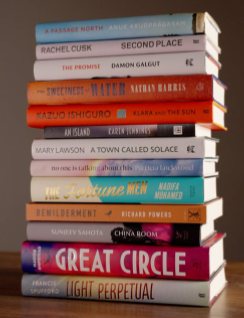
 Word by Word