
Six titles have been shortlisted for the 2025 Warwick Prize, established by the University of Warwick to address the gender imbalance in translated literature.
The prize highlights outstanding writing and aims to broaden the range of international women’s voices accessible to readers in the UK and Ireland. In its ninth year, from 145 eligible entries across 34 languages, came a longlist of 14 titles and now this shortlist of six titles from five languages.
Judges Comments
The judging panel of Boyd Tonkin, Susan Bassnett and Véronique Tadjo noted that the three remarkable novels on this year’s shortlist – by Evelyne Trouillot (Haiyi), Han Kang (South Korea) and Liliana Corobca (Romania) – deal in different but equally powerful ways with the traumas of history, and their long afterlives in memory, art and narrative.
“From Haiti, South Korea and the lands of the former Soviet Union, these books make the lingering shadows of the past into fully-realised experiences that can be transformed and redeemed by their telling.
“In contrast, Maylis Besserie reinvents the genre of the “artist-novel” with wit, compassion and ingenuity. Kristina Toth’s luminous and haunting poetry tells the story of a self, in public and private. And Johanna Ekström’s and Sigrid Rausing’s commanding end-of-life memoir looks, with singular craft and courage, at how all our stories end.
The 2025 shortlist, in alphabetical order, comprises:
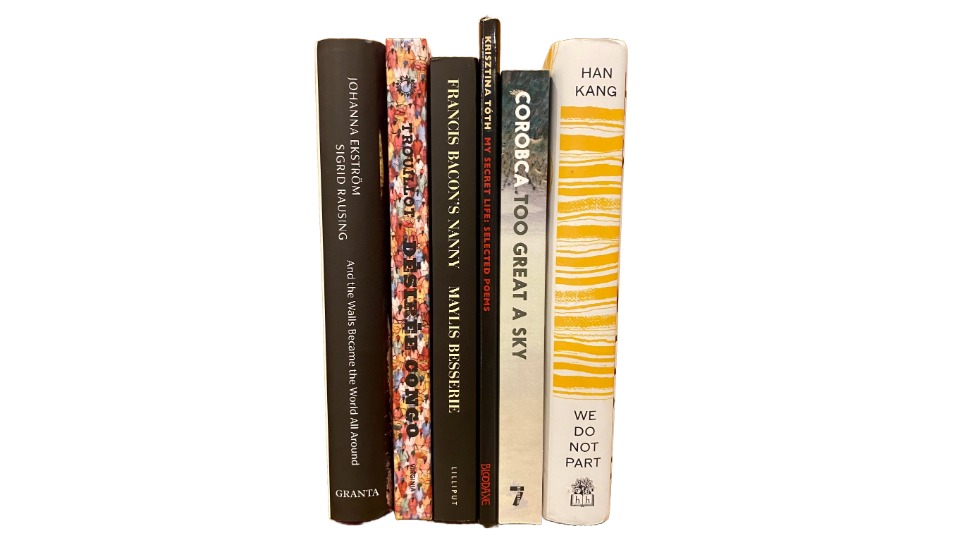
And the Walls Became the World All Around by Johanna Ekström and Sigrid Rausing (Sweden) (biographical memoir)
translated from Swedish by Sigrid Rausing (Granta)

– Johanna Ekstrom was a Swedish artist and writer who published over a dozen books of poetry, fiction and memoir in her lifetime. In 2022, ill with cancer, she asked her closest friend, Sigrid Rausing, to edit and finish her final book. Originally a memoir on the loss of a relationship during the pandemic, the focus shifted from the loss of love to, potentially, the loss of life.
These excerpts from Ekstrom’s notebooks interwoven with Rausing’s reflections on the text and on their friendship are a testament to a voice and a life; a book made in grief over the loss of a close friendship of over thirty years.
Désirée Congo by Evelyne Trouillot (Haiti) (Historial fiction)
translated from French by M.A. Salvodon (University of Virginia Press)

– Désirée Congo is a riveting, powerful, original novel set in the final years of the Haitian Revolution. In this richly textured work, Trouillot constructs an intricate web from the varied experiences of freedmen and women, maroons, enslaved African people and their Creole children, as well as French planters and white smallholders in colonial Saint-Domingue at a historical moment of upheaval.
A lyrical book whose characters enrich our understanding of the last confrontations between Haitian revolutionaries and Napoleon’s imperial forces; a conflict that resulted in the success of the largest slave revolt in recorded history and the independence of the first Black state in the western hemisphere.
Maylis Besserie, Francis Bacon’s Nanny (France) (Historical Fiction/ 20th Century Irish Art)
translated from French by Clíona Ní Ríordáin (The Lilliput Press)
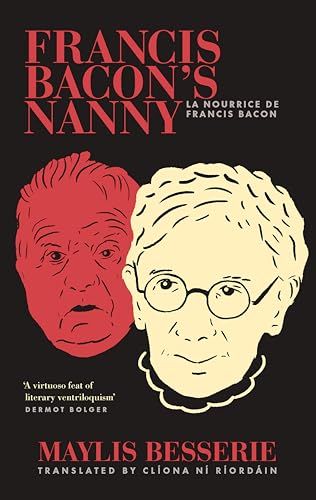
– At the centre of the life of the great artists was an unexpected life-long influences Jessie Lightfoot shielded a young Francis Bacon from the brutish violence of his bullying father, as well as from his worst self-immolating excesses later in life. The tenderness, wit and warmth of this inimitable Nanny stands in illuminating relief to the sulphurous palette that defined Bacon’s work.
Beyond the humour and heart of an extraordinary woman confronted with the shade and guile of the art world, Maylis Besserie offers a glimpse of Ireland in the first half of the 20th Centure, a place apart from the rest of the world, whose landscapes, imagery and animals haunted the painter’s canvases.
In the final of Maylis Besserie’s trilogy, her focus on the art and lives of artists who crossed borders between France and Ireland closes as Bacon confronts boundaries between the real and the imagined.
Krisztina Tóth, My Secret Life : Selected Poems (Hungary)
translated from Hungarian by George Szirtes (Bloodaxe Books)

– Krisztina Tóth is one of the leading Hungarian poets of the generation who began publishing in the late 1980s. The recipient of many awards, she is also renowned for her fiction which has been translated into many languages including English.
My Secret Life is the first book of Krisztina Tóth’s poetry in English translation. The poems were selected by her from five of her nine published collections, with the addition of some new or previously uncollected poems. This retrospective is translated by George Szirtes, winner of The King’s Gold Medal for Poetry, 2024.
‘Her work has the nervous energy of the times but is shaped by a deep and disciplined intelligence. Her subjects are invariably human. They are concerned with love, family, friendship, loss, and a kind of existential disaffection. Tragic in one sense but ever inventive, full of life’s minute yet highly resonant particulars, they seem to extend into an almost cinematic narrative about the cruelties of factory farming, murder, ageing, the treatment of women as sex toys and death itself. She is a bravura formalist when she needs to be. Her vigour and scope are enormous.’ – George Szirtes
Liliana Corobca, Too Great A Sky (Romania) (Historical fiction)
translated from Romanian by Monica Cure (Seven Stories Press UK)

The story of the deportation of Romanians from Bukovina to the steppes of Siberia in World War Two, an exercise in historical memory and a powerful story of maintaining humanity in impossible conditions.
Ana is eleven when the Soviet soldiers send her from Bukovina, Romania, to Kazakhstan. She is just one of many forced to leave behind her home and make the three-week long journey via freight train. The trip is a harsh, humiliating one, but in spite of the cold and the closeness of death, life persists in the train wagon in the form of storytelling, riddles, and ritual.
Years later, Ana recalls her childhood for her great-granddaughter, who is considering moving her to a nursing home. Her story, told with unflinching candour, is a chronicle of a life lived during a time of great political and national change, a story of an existence defined and curtailed by lines drawn on a map.
Han Kang, We Do Not Part (South Korea) (Historical fiction)
translated from Korean by e. yaewon and Paige Aniyah Morris (Hamish Hamilton, Penguin Random House UK)
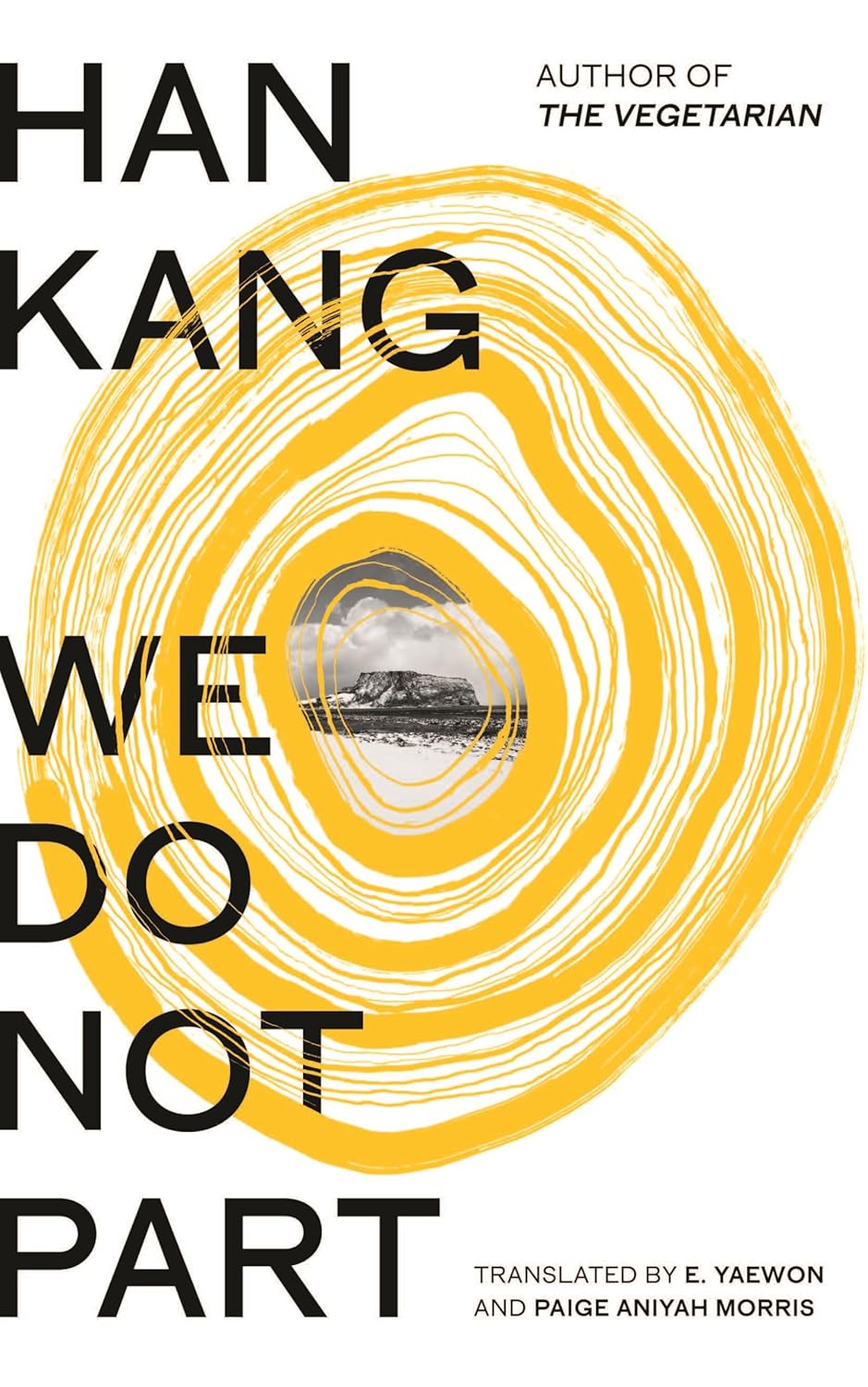
– One morning in December, Kyungha is called to her friend Inseon’s hospital bedside. Airlifted to Seoul for an operation following a wood-chopping accident, Inseon is bedridden and begs Kyungha to take the first plane to her home on Jeju Island to feed her pet bird, who will quickly die unless it receives food.
As Kyungha arrives a snowstorm hits. Lost in a world of snow, she begins to wonder if she will arrive in time to save the bird – or even survive the terrible cold that envelops her with every step. She doesn’t yet suspect the darkness awaiting at her friend’s house.
There, the long-buried story of Inseon’s family surges into light, in dreams and memories passed from mother to daughter, and in a painstakingly assembled archive, documenting the terrible massacre 70 years before that saw 30,000 Jeju civilians murdered.
We Do Not Part is a hymn to friendship, a eulogy to the imagination, and above all a powerful indictment against forgetting.
* * * * * *
The winner will be announced on 27 November 2025 at a ceremony in London.
Have you read any of the six books shortlisted? Let us know in the comments below.
 Word by Word