
Next book on my pile for Reading Ireland Month 2025, a brilliant work of historical fiction, set in 1540 -1561 Renaissance Italy, a gripping, excellent tale.
The Accidental Deaths of Young Wives
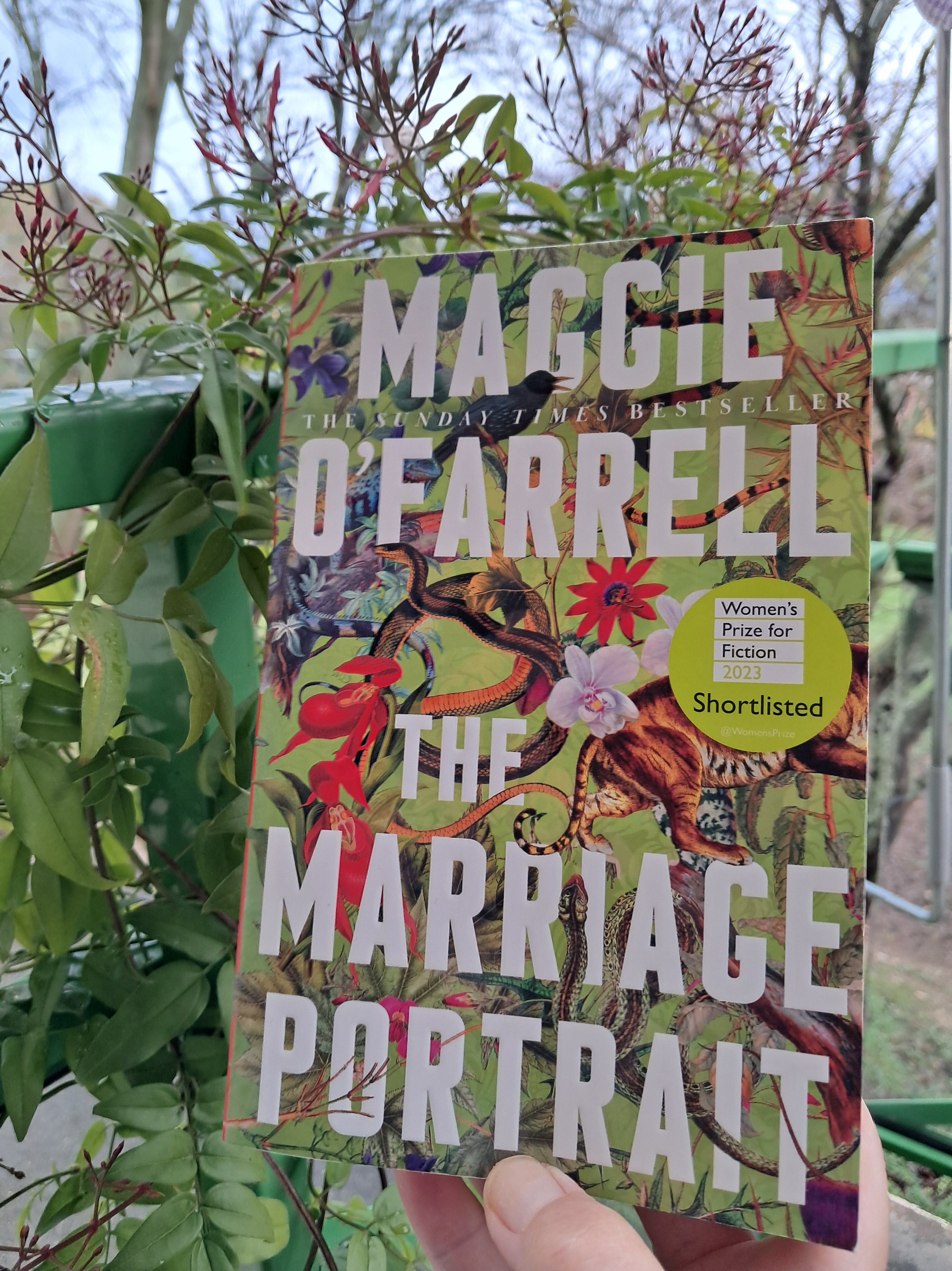
The Marriage Portrait opens with an historical note, prior to the opening chapter ‘a wild and lonely place’ in which our main protagonist Lucrezia de’ Medici has been brought to an isolated fortress by her husband, without her maid or usual retinue. In her state of fear, she recalls her sister-in-laws hoarse whisper ‘you will be blamed’.
Historical Note
In 1560, fifteen-year-old Lucrezia di Cosimo de’ Medici left Florence to begin her married life with Alfonso II d’Este, Duke of Ferrara.
Less than a year later, she would be dead.
The official cause of her death was given as ‘putrid fever’, but it was rumoured that she had been murdered by her husband.
Lucrezia de’ Medici, the replacement
The novel tells a story of Lucrezia of Florence, who, due to the death of her older sister Maria, becomes the intended fiance of the man her sister was going to marry, Alfonso of Ferrara, news that Lucrezia overheard before it was announced.
She had extraordinarily sensitive hearing: she could hear what was being said, sometimes, on the floor below, or at the other end of the largest state room. The palazzo was a place of strange acoustics, with sound and vibrations, whispers and footsteps journeying along the joists, behind the marble reliefs, up the spines of statues, through the bubbling waters of the fountains. Lucrezia, even aged seven, found that if she pressed the outer folds of her ear to the panelling or frame of a door, it was possible to find out all sorts of things.
Thanks to the close relationship she has with Sophia, a nurse-maid, they manage to hide her entry into womanhood at 13, delaying the pending marriage; however, by the age of 15 she becomes the new Duchess.
By the time the four eldest children of the ruling family were approaching the end of their childhood, their futures were already mapped out for them. Their parents and emissaries and secretaries and advisers had been working on these plans since the children’s births.
Life at the Palazzo Veccchio, Florence
After the creepy opening chapter in 1561, the narrative returns to 1544 Florence, the year of her conception, and subsequent chapters depict memories and events from her childhood in Florence. There is one scene where her father, orders a tiger to be brought to his palace. When the children are shown the tiger, Lucrezia lags behind and waits for it to appear from behind the darkened interior of its cage and lays a hand on it.

The appearance of the tiger, its entrapment and the suppression of its nature, perhaps foretell her own future, where women of such families are traded like exotic animals, chattels born into one family to be traded into another, expected to produce heirs, to facilitate territorial occupation, to be observed, painted; rarely to express opinions or be expert at much beyond the limits of the walls they are encased by.
While her brothers have been coached and trained to rule, she sees it is only her vital will that will protect her, that will never yield.
If she is to survive this marriage, or perhaps even to thrive within it, she must preserve this part of herself and keep it away from him, separate, sacred. She will surround it with a thorn-thicket or a high fence, like a castle in a folktale; she will station bare-toothed, long-clawed beasts at its doors. He will never know it, never see it, never reach it. He shall not penetrate it.
The more time she spends around Alfonso, the less she understands of his nature, one moment tender, the next cruel and indifferent.
A Year of Wifedom and Wretchedness
The novel moves back and forth in time during that year of her marriage, telling the story of the days leading up to her marriage, the initial stay with her new husband in a country villa, then flicking forward in time to a more sombre, fortified country property where he has taken her alone, where she feels threatened by a strong premonition that she is to die, by his hand.
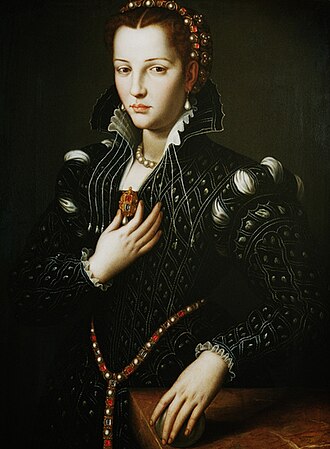
During the early days of their marriage, Alfonso engages a well known artist of a certain style of portraiture and fresco art, one that Lucrezia doesn’t particularly like – to create ‘the marriage portrait’ of his Duchess.
A note sent early to her door, in her husband’s handwriting: she is to be painted in an outfit designed to his specification, which was delivered late last night. Would she please put it on, along with the betrothal gift, and come down to the salon?
The simultaneously told timelines all converge as the portrait is unveiled and the Duchess finds herself at her most vulnerable, alone, either in the grip of madness or about to become victim to the predator.
Vividly Imagined, Underlying Suspense, a Young Woman Honoured
I was totally gripped by the story from those suggestive opening pages, the effect of beginning the story so near its end, created an underlying tension and suspicion all the way through, even as she goes into the marriage with optimism.
The character of Lucrezia is beautifully constructed and rich in visual imagery thanks to her artistic inclinations, despite the fact that she is often confined to quarters. The era of Renaissance Italy, the day to day lives, the close environment of these dynastic families is intricately portrayed and sumptuously imagined. I love that Maggie O’Farrell has resurrected this fifth child, taken so young and breathed new life into her story.
Highly Recommended if you like lush period pieces and the hidden dramas of olden day, wealthy land owners with political and societal influence and historical characters who get to show us how it might have been.
Let us know in the comments if you have read The Marriage Portrait and what you thought of it.
Further Reading
My Review of Maggie O’Farrell’s memoir, I Am, I Am, I Am, Seventeen Brushes With Death
My Review of Maggie O’Farrell’s work of Historical fiction Hamnet
My review of Maggie O’Farrell’s The Hand That First Held Mine
Author, Maggie O’Farrell
Maggie O’Farrell is a Northern Irish novelist, now one of Britain’s most acclaimed and popular contemporary fiction authors whose work has been translated into over 30 languages.
Her debut novel After You’d Gone won the Betty Trask Award and The Hand That First Held Mine the Costa Novel Award (2010). She is the author of Hamnet, winner of the Women’s Prize for Fiction 2020, and the memoir I Am, I Am, I Am, both Sunday Times No.1 bestsellers.
Her novels include After You’d Gone, My Lover’s Lover, The Distance Between Us, winner of a Somerset Maugham Award, The Vanishing Act of Esme Lennox, The Hand That First Held Mine, winner of the 2010 Costa Novel Award, Instructions for a Heatwave, This Must Be the Place and The Marriage Portrait, shortlisted for the Women’s Prize. She lives in Edinburgh.

 Word by Word
I read this when it first came out, and remember thoroughly immersing myself in Lucrezia’s life and times. A little later it was discussed in our book group, and I was unable to go, but friends reported afterwards that it had a very mixed reception, but I can’t remember why. I find it hard t imagine not enjoying a Maggie O’Farrell!
LikeLiked by 1 person
I’m reading g at the same time as a Goodreads book group and I know are put off by the menagerie of animals kept below the palace, certainly reading about their way of life and the ease of dispensing with rebllious or seemingly infertile women is going to be an uncomfortable read for sensitives. I was totally immersed and glad this one short-lived woman got another lease on life.
LikeLike
Different times, different mores. If you’re going to read about them, you have to cope with what’s going on in them, non?
LikeLiked by 1 person
Yes exactly, it’s important to understand how animals and humans have been treated through time, even the privileged and the caged do not escape the avarices of man.
LikeLiked by 1 person
Ordinarily I’m not into historical fiction but I was totally engrossed in this one.
LikeLiked by 1 person
It feels like this novel goes beyond what we might expect from the genre, which isn’t surprising given the author doesn’t specialise in one particular genre, she is able to create suspense and weave in great description and historical detail without it slowing down the narrative!
LikeLike
Oh this sounds so good!
LikeLiked by 1 person
Totally immersive, one for the summer!
LikeLike
I preferred this to Hamnet! It was very engrossing.
LikeLiked by 1 person
I think it may be my favourite of hers too.
LikeLike
Pingback: It’s Reading Ireland Month 2025!
I picked up a 99p Kindle version of this and am looking forward to it very much. Lovely review, Claire!
LikeLiked by 1 person
Excellent, I discovered a few of the longlist very reasonably priced as ebooks as well. Makes it easier to join the fun!
LikeLiked by 1 person
I loved this book, although found it very disturbing. I was fascinated to learn that the actual portrait is in the Raleigh Art Museum, which I visited once as a teen (possibly before the portrait was there). I plan to return there sometime in the next few years.
LikeLiked by 1 person
Oh wow, that would be quite something to visit and see the portrait.
LikeLike
I tried, 2 chapters, will try again. I loved ‘Hamnet’ and ‘This Must be the Place’ and she is one of my favorite forever-authors, but I found this book difficult to get into, partly because of the first chapter ‘reveal’–but I’m coming back.
LikeLike
Pingback: Best Reads of 2025 Top Fiction – Word by Word
Pingback: The Vanishing Act of Esme Lennox (2006) by Maggie O’Farrell – Word by Word