
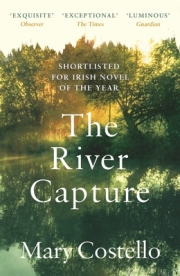
After reading Mary Costello’s short stories The China Factory recently, I was looking forward to one of her novels and I chose to start with The River Capture, in part due to its connection to James Joyce, as I also planned to read Nora: A Love Story of Nora and James Joyce in April.
I understood I was not going to pick up the references to Ulysses as I haven’t read it, so I looked up its description, structure and characters, just so I wasn’t completely ignorant of it. This was enough of an introduction to be helpful to my reading of the novel.
 The first two thirds of the book is the story of Luke, a young man who has taken a year out from his teaching job in Dublin and returned to the home he inherited from his parents.
He is up and down in his moods, by turns hopeful and melancholic. We learn he was close to an Aunt that recently passed away and there is another Aunt Ellen, who he visits regularly, is there for her when needed.
He took a career break four years ago with the intention of doing something – writing a book perhaps – on Joyce or even Bloom. It was more than a whim, more than a money-making enterprise, though that too. It was an itch, a longing – a necessity even – to stay close to Bloom, to inhabit him day and night.
We are aware he was in a relationship in the past and that possibly his current situation is due in part to that loss as well. Fragments of his past are drip fed throughout the present narrative.
The world was his oyster then too. He had his life all mapped out – a few more years in the city, then he’d come back here with Maeve, work the land, fill the house with kids. Mammy, Josie, Ellen, the whole happy racket, like in the old days.
His thoughts alternate between thinking about Joyce and thinking about his own past.
He must not exhaust himself thinking. Random inchoate thoughts following on more random inchoate thoughts. Thought is the thought of thought. The pressure of thoughts sometimes, ideas turning cartwheels in his mind. Coming in surges, fast-flowing, flooding. All is in all. His speech too, at times. His father always at him. ‘Easy Luke, easy, slow down.’

Photo by H. Muleba on Pexels.com
One morning a young woman arrives at his doorstep with a request, it is the beginning of a new friendship and he begins to anticipate her visits and look forward to things.
Unknown to the two young people, there is interconnected family history. His Aunt has strong feelings about events that happened long in the past and makes sure Luke understands how she feels.
‘Family is everything,’ she says quietly. ‘Blood is everything.’ Her voice is remote. Thinking of his mother, Sarah, maybe, who was not blood to her. Two strong women, once as close as sisters, growing gradually hostile towards each other over the years. From long summers spent sharing the kitchen, the initial joy of annual reunions to antagonism.
At the point that this history is revealed, the narrative changes and the Ulysses reference makes a significant impact on the structure of the narrative. The plot is arrested, and what follows are a multitude of questions or instructions and their answers about thoughts, memories, images, aspects of this story or about the text of Ulysses.
Melissa Harrison in her review observes of Luke:
A Joyce obsessive whose plans for a book have come to nothing, Luke is so immersed in Ulysses that he thinks in its language and rhythms, and sees parallels with Leopold Bloom, Stephen Dedalus and Joyce himself in the most minor occurrences of everyday life.
Some of the passages relate to the story we are reading and others relate to random other things.
Unfortunately for me, this change in structure midway into the storytelling was frustrating and I couldn’t appreciate it. I found myself skipping some passages because I wasn’t interested in those subjects outside the story line. While other passages continued the story line, the abrupt change in format, having become used to a different style for the first 140 pages, felt like an imposition.

Photo by Anne Barca on Pexels.com
The questions run like this:
After reading the files, what action does Luke take?
Amid the emotional disconcertment, what pleasing patch of reverie does he stray upon?
Rising, finally, what does Luke do?
What fear suddenly assails him?
Has he had prior noonday visitations from the noonday demon?
What mental attitude – followed by physical action – does he use adopt to fight the demon?
What bodily posture does Luke adopt on leaving the house?
What dominant thoughts emerge from the riot of all others as he proceeds down the avenue?
The River Capture is a metaphor for the way one river captures or swallows another, a natural phenomenon of geography and this is what happens in the novel, one part of the narrative captures the other, taking our attention away from the sad reality of what is occurring.
Further Reading
The Guardian : Reviewed by Melissa Harrison – audacious literary ventriloquism – This beautifully modulated novel about a Joyce obsessive whose life has stalled bends Ulysses to its own ends.
Read reviews by JacquiWine and Lisa here.
 Word by Word