
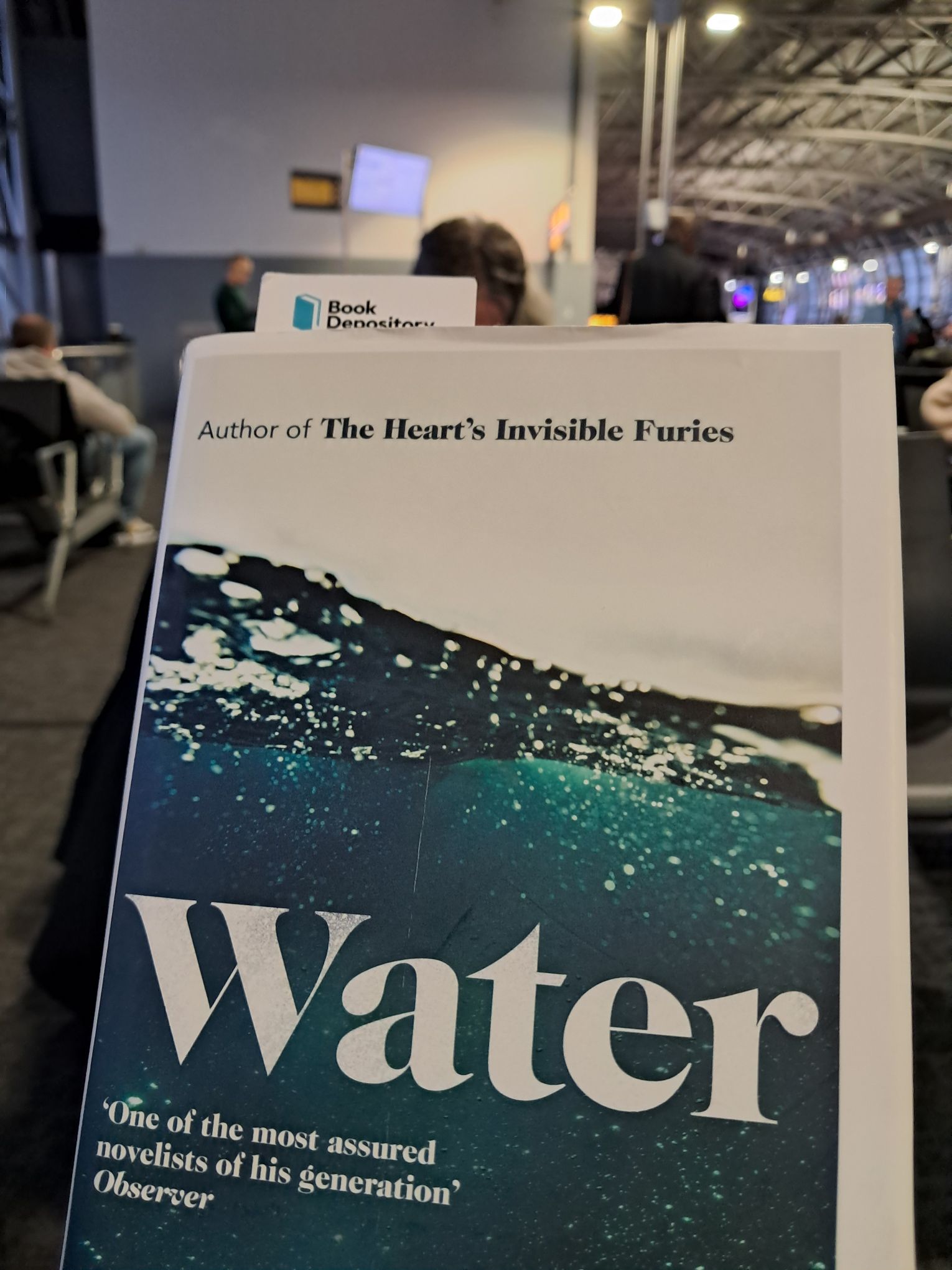
I found this beautiful hard copy of Irish author John Boyne’s short novel Water in a second hand bookstore on holiday recently. I had put too many books in my suitcase already so I shouldn’t have been buying more, but this was too tempting, especially as water was one of the great themes of my holiday.
I did leave most of the books I took with me behind, but Water was my in-flight read on my return, and a good choice as it is not too long or complicated.
The only issue I have, is that it is part of a series of four short novels, interconnected stories. Now I want to know what will happen next and I don’t have Earth or Fire on my shelves yet. Air is due to be published in May 2025.
On verra, as we say here in France. We will see.
Irish Island Stories
Water is another Irish Island story, I realise I have read a few of these kind of stories in recent times, where a character either lives on an island or goes off to spend time on an island for some reason.
In 2024, I read Hagstone by Sinead Gleeson about an artist Nell, who lives on a wild and rugged island that is also inhabited by a commune of women trying to live outside society and I also read Sophie White’s literary horror Where I End, again set on an Irish island, with a strange cast of characters with their terrible secrets. I see another one coming in 2025, June O’Sullivan’s historical fiction set in 1867, The Lighthouse Keeper’s Wife set on the extremely isolated island of Skellig Michael off the coast of Kerry.
In a sense all Irish literature is island literature, but there is something particular about setting stories on small islands with their slightly insular communities that magnify the issues the story is trying to project.


Not an island, a continent. A few favourite water pictures from my recent holiday.
Change a Name, Change a Life
When Vanessa Carvin arrives on the island, she changes her name to Willow and shaves her hair. Content to learn that the cottage she rented had no Wi-Fi or television, we understand she is someone that might be recognised and that is the last thing she wants. We do not know why, the past will be slowly revealed over the course of the novel.
When a cat saunters in and makes itself at home, she thinks of her elder daughter Rebecca and husband Brendan, though what happened to separate her from them remains a mystery.
Well, he’s surrounded by chaos now, I tell myself, wondering whether I should smile at the irony but being unable to. Although he’s technically not my ex-husband at all yet. I just think of him that way. One day, I will summon the energy to speak to a solicitor but, right now, I have had enough of the legal system to last me a lifetime, and who knows, maybe he’ll die, or be killed; which would save me both the bother and the expense.
Contemplation and Conversations
Though she has come to the island to get away, she does interact with the locals and news of her arrival travels quickly. She develops a routine and keeps checking to see if her daughter has read her messages. For some reason her elder daughter isn’t speaking to her and early on we learn that the younger daughter Emma has died.
The way the novel holds much back from the reader while we follow Willow around, in a way reflects the characters own blindness and denial around what has occurred to her family. The island becomes a refuge or escape from reality while the new name and change in appearance physical appearance create a mask behind which she has time to contemplate the events that have occurred and her own complicity.
I was never what you might call a natural mother, but I loved my daughters and did everything I could to ensure that they enjoyed a happy and secure childhood. My own had been untroubled and , having come through it without any noticeable scars, I simply emulated my own mother’s behaviour. Businesslike and efficient, without being overly sugary.
Despite this, none of the family are now together and a scandal has rocked the illusion of her foundation. Although she is there to reflect on the situation and her own role in it, she quickly finds her own form of escapism with her neighbour’s son. The conversations she has with various island inhabitants inform us on the state of the Irish psyche and proclivities, it’s own form of blindness and denial.
Her conversation with the island priest on observing a young man seeking confession is revealing:
‘When I was his age, we all had to go,’ I tell him. ‘It would have been unheard of not to. And I brought my own children too, even though I’m not a believer. So I suppose that makes me just as big a hypocrite.’
‘But something must have made you bring them,’ he insists. ‘Perhaps some part of you was hoping to receive the Spirit, even if you didn’t realise it?’
‘I brought them to keep my husband happy,’ I tell him. ‘I don’t know how much you know about Irish women, Ifechi, but that’s what we do. It’s what we’ve been doing for centuries now, and look where it’s got us.’
‘And where is that?’
‘Here. To some godforsaken island in the Atlantic Ocean, where we know no one and no one knows us.’
Complex and Conflicting Truths

John Boyne adeptly walks his character through her isolation and interactions, penetrating the dark, hidden aspects of outwardly normalised lives that are so far from it, they are no longer able to see the signs of damaging dysfunction.
Symbolically, water represents depth, the ebb and flow of life, the things we should know, that sometimes we only come to know in the stillness of being. Water can cure, purify, cleanse and provide insight. Leaving the city behind, crossing the water to an island, Willow will plunge the depths to awaken to her own role in her not seeing.
It is interesting that the author chose to inhabit the character of a woman, that adds to the theme of blindness or unknowing in the novel. That element of not seeing what is happening, and the usual repression of the feminine within the masculine.

Here an author steps into those shoes and we go there with him to see what it feels like from the inside and witness the progress that can be made by making time to sit with situations that require contemplation, resolution and healing.
Highly Recommended.
Have you read any of the novels in John Boyne’s Element series?
 Word by Word
I was delighted to read this lovely review as I have a Kindle copy of this novella. I’ve never actually read John Boyne before and often I hesitate before a male author narrating a female main protagonist, but it was 99p and worth a go, I felt. I’m looking forward to it now!
LikeLiked by 1 person
Yes, I know what you mean. I’m not sure it’s entirely successful at convincing me of the authenticity of the female protagonist…
LikeLiked by 1 person
I’ve read the three that are currently available and enjoyed them all. So different, and yet each so cleverly gives bit parts to the main protagonists in the other books in the series.
LikeLiked by 1 person
I’m looking forward to seeing where it goes next!
LikeLiked by 1 person
Inded. And luckily it doesn’t matter what order you read them in.
LikeLiked by 1 person
That’s good to know.
LikeLiked by 1 person
I am thrilled this book found you! I am a huge John Boyne fan and have followed this book tour so have a gorgeous collection of hard back signed copies! The first three books are all incredible – he handles the difficult topics deftly. You definitely need to add the rest to your TBR pile!
LikeLiked by 1 person
Oh, that makes me not want to wait now! I might have to try and get them before Read Ireland in March!
LikeLiked by 1 person
You should!
LikeLike
I haven’t and I really must!
LikeLiked by 1 person
Yes! All aboard. 🙂
LikeLiked by 1 person
Pingback: Reading Ireland Month 2025 – Word by Word